Summary PyTorch stands out as a versatile tool for machine learning projects due to its dynamic computation graphs and efficient GPU acceleration. It supports rapid prototyping and experimentation, making it highly suitable for research applications. Its comprehensive ecosystem aids development across various AI domains.
PyTorch
PyTorch is a deep learning framework ideal for researchers and developers, offering dynamic tensor computation and flexible neural network building.
Community:
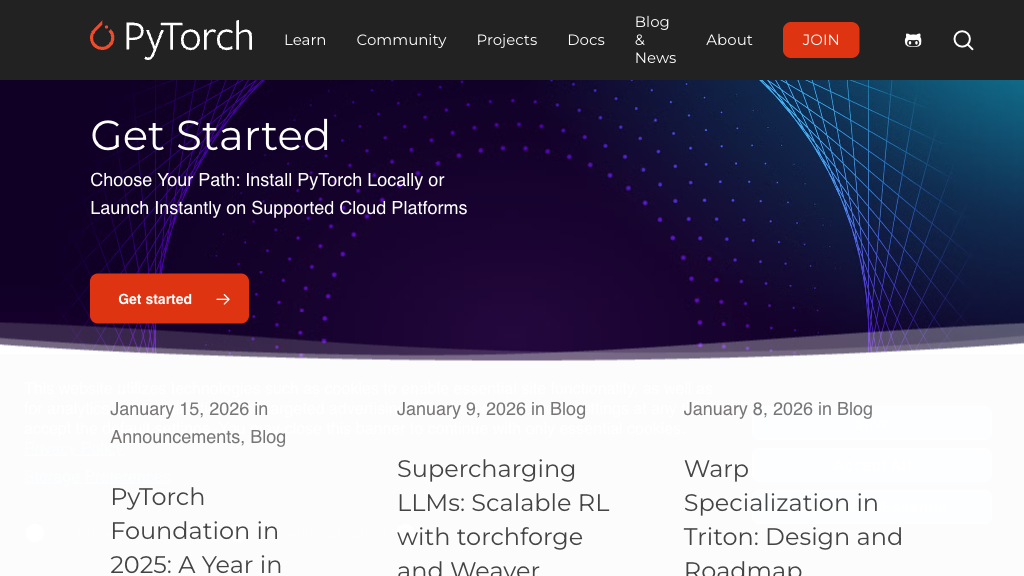
PyTorch - Reviews: User Feedback, Features, Pros & Cons
Key Features
- Dynamic Computation Graphs: Allows flexible model adjustments during runtime.
- Tensor Computation with GPU Acceleration: Enhances performance with efficient tensor operations.
- Automatic Differentiation (Autograd): Simplifies gradient calculation for neural networks.
- Robust Ecosystem: Provides libraries tailored to vision, text, and audio tasks.
Typical Use Cases
Research and Experimentation
A popular choice among academics for testing innovative models due to its adaptable design.
A popular choice among academics for testing innovative models due to its adaptable design.
Natural Language Processing
Utilized in various NLP tasks such as sentiment analysis and machine translation.
Utilized in various NLP tasks such as sentiment analysis and machine translation.
Computer Vision
Applied in image recognition and object detection, crucial in fields like medical imaging.
Applied in image recognition and object detection, crucial in fields like medical imaging.
Best For
- AI Researchers (because of its flexibility in model experimentation)
- NLP Developers (because of specialized libraries supporting text tasks)
- Data Scientists (because of efficient tensor computations)
Read More
Avoid
- Complete beginners in AI development
- Teams seeking out-of-the-box deployment solutions
- Projects requiring non-Python programming environments
Pricing Overview
PyTorch is an open-source framework available at no cost, making it accessible for both individual developers and large organizations.
FAQ
- What is PyTorch?
PyTorch is an open-source deep learning framework that provides dynamic tensor computation and automatic differentiation, widely used for AI research and production. - How does PyTorch handle automatic differentiation?
PyTorch uses a tape-based autograd system that records operations on tensors to automatically compute gradients during backpropagation. - What are tensors in PyTorch?
Tensors are multi-dimensional arrays similar to NumPy arrays, which can run on CPU or GPU to perform efficient numerical computations. - Can PyTorch models be deployed in production?
Yes, PyTorch supports model serialization with TorchScript and scalable deployment using TorchServe. - Is PyTorch suitable for distributed training?
Yes, PyTorch provides a distributed backend enabling scalable training across multiple GPUs and machines. - What programming languages does PyTorch support?
PyTorch primarily supports Python with a well-developed API, and also offers a C++ interface for performance-critical applications. - How does PyTorch compare to other deep learning frameworks?
PyTorch offers dynamic computation graphs and a more intuitive programming model, making it popular for research and rapid prototyping.
Verdict
Overall, PyTorch is a powerful tool well-suited for researchers and developers who require flexibility in their AI projects. Its extensive library support enhances productivity across various domains. However, those seeking straightforward production solutions might need additional resources to optimize deployment processes effectively.
PyTorch Reviews
No reviews
Top Regions of PyTorch
🇺🇸United States:18.66%
🇨🇳CN:16.37%
🇭🇰HK:5.90%
🇮🇳India:5.47%
🇰🇷KR:4.33%
🌍Others:49.27%
PyTorch Traffic Trends
Monthly Visits: 1.99M