Summary Benchling is a versatile platform that streamlines life sciences research by centralizing data and automating workflows. It facilitates collaboration among teams and enhances productivity through its intuitive interface. While some users may experience a learning curve, the benefits outweigh the initial setup effort.
Benchling
Benchling is a cloud-native platform for life sciences R&D, ideal for biotech and pharma teams needing data centralization and workflow automation.
Community:
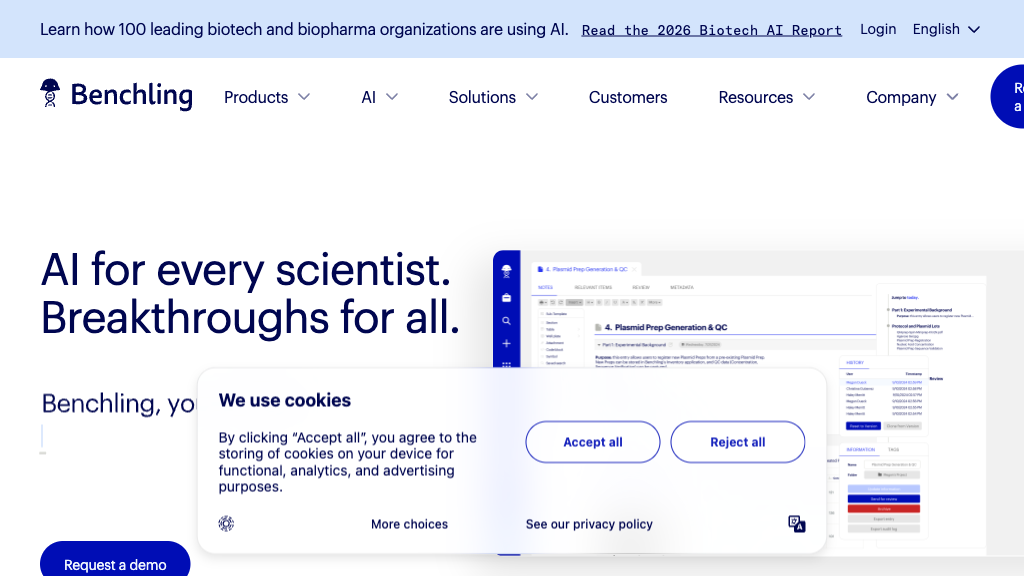
Benchling - Reviews: User Feedback, Features, Pros & Cons
Key Features
- Unified Data Model: Centralizes scientific data across experiments for complete traceability.
- Workflow Automation: Reduces manual errors by automating repetitive tasks.
- Collaborative Cloud Notebook: Enables real-time experiment sharing with an intuitive interface.
- Extensible Platform and Integrations: Connects with third-party software to unify data ecosystems.
Typical Use Cases
Biotech and Pharmaceutical R&D
Enhances drug discovery processes by managing complex data and workflows efficiently.
Enhances drug discovery processes by managing complex data and workflows efficiently.
Molecular Design and Analysis
Facilitates design and analysis of biomolecules using integrated tools.
Facilitates design and analysis of biomolecules using integrated tools.
Sample and Inventory Management
Keeps track of samples and reagents with detailed traceability across labs.
Keeps track of samples and reagents with detailed traceability across labs.
Best For
- Biotech companies (because they need efficient data management)
- Pharmaceutical firms (because they require streamlined R&D processes)
- Research institutions (because they benefit from collaborative tools)
Read More
Avoid
- Small labs with minimal digital infrastructure
- Organizations not requiring extensive data integration
- Teams resistant to adopting new digital tools
Pricing Overview
The platform offers scalable solutions suitable for both startups and large enterprises, adapting to various organizational needs without public pricing details.
FAQ
- What types of scientific data can Benchling manage?
Benchling manages data related to biomolecules, cell lines, reagents, experimental results, and inventory with full traceability. - Is Benchling suitable for regulated environments?
Yes, Benchling is compliance-ready with features supporting regulatory standards and SOC 2 Type 2 security certification. - Can Benchling integrate with existing lab instruments and software?
Yes, Benchling offers APIs and integrations to connect with lab instruments, third-party software, and custom applications. - How does Benchling improve collaboration among research teams?
It provides a cloud-based, shared workspace where teams can plan, record, and review experiments in real time.
Verdict
Overall, Benchling stands out as a robust tool in the realm of life sciences R&D platforms. It effectively improves efficiency through automation while facilitating seamless team collaboration. However, potential users should consider their readiness to adapt to new systems before integrating it into their workflows.
Benchling Reviews
No reviews
Top Regions of Benchling
🇺🇸United States:58.00%
🇩🇪DE:6.79%
🇬🇧United Kingdom:5.78%
🇨🇦CA:4.17%
🇧🇪BE:4.12%
🌍Others:21.13%
Benchling Traffic Trends
Monthly Visits: 1.23M